
Product Overview
SND-R05 Ultra-High Friability RVG
Diamond Powder is a synthetic diamond
abrasive developed primarily for resin-bond
precision grinding wheels. It represents the
ultra-high-friability position within the
SinoDiam SND-R series.
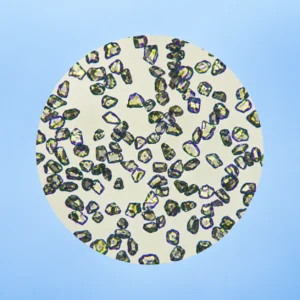
Its friable crystal structure is designed to
promote controlled microfracturing
during grinding. As individual abrasive grains
fracture, new cutting edges can be exposed,
supporting a self-sharpening and free-cutting
grinding mechanism.
This abrasive behavior is particularly relevant
to grinding operations where excessive grinding
forces, wheel glazing and workpiece surface
damage are important concerns.
SND-R05 is recommended for evaluation in
resin-bond diamond wheels processing
tungsten carbide, cermets, technical
ceramics and selected hard-glass materials.
Its suitability for sapphire and other
difficult-to-grind brittle materials should
be established through application trials.
The final grinding performance depends on
particle size, crystal retention, bond
formulation, wheel conditioning and
operating parameters.
Technical Specifications
SND-R05
RVG Synthetic Diamond Grit
Ultra-High Friability
Highest Friability in SND-R Series
Gray
Resin Bond
Phenolic / Polyimide
Vitrified Bond – Trial Required
Microfracturing / Self-Sharpening
Confirm by Application
Friability is a relative product-grade
classification. Quantitative fracture
strength, particle-size distribution and
application performance should be confirmed
using the relevant test methods and
product-specific technical data.
Crystal Characteristics & Grinding Behavior
Ultra-High Friability
SND-R05 is positioned as a highly
friable abrasive grade relative to
other SinoDiam SND-R products.
This positioning is intended for
applications requiring relatively
easy abrasive grain fracture.
Controlled Microfracturing
During suitable grinding conditions,
diamond crystals can fracture into
smaller cutting fragments, exposing
additional cutting edges and helping
renew abrasive sharpness.
Free-Cutting Characteristics
A self-sharpening grain can help
reduce the tendency toward abrasive
dulling and wheel glazing.
Actual cutting behavior depends on
grain retention and wheel design.
Low-Force Grinding Potential
Highly friable abrasives are often
evaluated where reduced grinding force
and protection of brittle workpieces
are priorities. The achievable result
requires process validation.
Recommended Applications
The following are relevant application
targets for highly friable resin-bond
diamond abrasives. Final suitability of
SND-R05 must be verified for the specific
grinding wheel and workpiece.
Tungsten Carbide Grinding
For evaluation in resin-bond diamond
wheels used for carbide cutting-tool
sharpening, edge grinding and precision
finishing. Important selection factors
include carbide composition, grinding
force, wheel wear and edge integrity.
Cermet Components
Highly friable diamond abrasives can
be considered for controlled grinding
of selected cermet components, where
workpiece edge quality and grinding
forces require careful management.
Technical Ceramics
Potential applications include
precision grinding of selected
engineering ceramics. Evaluation
should consider material brittleness,
subsurface damage, abrasive wear
and surface integrity.
Hard Glass & Brittle Materials
Suitable for application trials in
hard-glass grinding and selected
brittle-material finishing operations.
Grinding parameters and abrasive size
should be matched to the workpiece.
Sapphire Grinding Evaluation
Sapphire may require specialized
grinding-wheel formulations. SND-R05
should be evaluated through trials
for cutting action, wheel wear and
achievable surface quality.
Precision Tool & Mold Components
Applicable to the evaluation of
precision grinding processes for
suitable carbide, ceramic or other
hard-and-brittle tooling components.
Workpiece composition is essential.
Mesh Size Selection & Surface Finish
Diamond grit size influences cutting
point density, material removal rate,
wheel loading and achievable surface
finish. The selected mesh should match
the grinding stage and wheel formulation.
Coarser Grit
Evaluate for higher stock-removal
requirements where the wheel design
and workpiece allow.
Intermediate Grit
Evaluate for a balance between
material removal, abrasive
wear and finishing requirements.
Finer Grit
Evaluate for precision grinding
and demanding surface-quality
requirements.
Contact SinoDiam to confirm specific
SND-R05 mesh sizes, size-distribution
requirements and the applicable
grading standard. Grit-size selection
alone does not guarantee a particular
surface roughness value.
Resin Bond Compatibility & Wheel Design
SND-R05 is primarily intended for
resin-bond diamond grinding wheels.
Selection may include phenolic and
polyimide resin formulations, subject
to the wheel manufacturing process
and actual grinding conditions.
Because highly friable crystals can
break down relatively easily, the
abrasive must be matched with an
appropriate bond system to manage
the balance between self-sharpening
and premature grain loss.
Important Wheel Design Considerations
- Diamond concentration and grit-size distribution.
- Resin type, bond hardness and curing conditions.
- Grain retention and abrasive exposure.
- Wheel structure, geometry and dressing method.
- Wet or dry grinding conditions and thermal load.
- Required grinding ratio (G-Ratio) and wheel life.
Vitrified-bond applications should be
evaluated separately, with particular
attention to bond chemistry, firing
conditions and abrasive compatibility.
SinoDiam SND-R Series Grade Selection
SinoDiam offers four resin-bond diamond
grades for different abrasive fracture
and grinding-tool requirements.
The grades should be compared using
actual crystal characteristics, bond
compatibility and application trials.
Ultra-High Friability · Current Grade
Focused on highly friable abrasive
behavior, controlled grain fracture
and self-sharpening in precision grinding.
The technical positioning of SND-R10,
SND-R15 and SND-R20 should be verified
using their individual grade specifications.
Grade comparison does not imply
direct equivalence to other manufacturers’
commercial products.
Frequently Asked Questions
1. What is SND-R05 resin bond diamond grit?
synthetic diamond abrasive developed
primarily for resin-bond grinding wheels.
Its key selection characteristic is
the ability of friable grains to
undergo controlled fracture during
suitable grinding conditions.
2. What does ultra-high friability mean?
of an abrasive grain to fracture
under an applied load. A more
friable diamond generally breaks
down more readily than a tougher
grade under comparable conditions.
Actual behavior also depends on
particle size and test method.
3. How does SND-R05 support self-sharpening?
controlled microfracturing, new
cutting edges may be exposed.
This can help maintain abrasive
cutting action and limit dulling,
depending on the bond system
and grinding conditions.
4. What materials can SND-R05 be used for?
include tungsten carbide, cermets,
technical ceramics and selected
hard-glass materials. Sapphire
and other difficult-to-grind
materials require additional
application evaluation.
5. Does SND-R05 always produce lower grinding forces?
support free-cutting behavior,
but grinding force depends on
grit size, diamond concentration,
bond hardness, dressing and
operating conditions. Performance
must be verified in the complete
grinding-wheel system.
6. Does higher friability always improve wheel life?
self-sharpening, but excessive
grain breakdown or premature
grain loss can increase abrasive
consumption. Wheel life and
grinding ratio should be evaluated
together with material removal
and surface quality.
7. Can SND-R05 achieve a mirror finish?
fine-grinding operations targeting
high surface quality. A specific
surface roughness, including any
Ra value, cannot be guaranteed
by diamond grade alone. Results
depend on the complete process.
8. Is SND-R05 suitable for phenolic or polyimide resin bonds?
for resin-bond grinding systems.
Phenolic and polyimide formulations
can be evaluated according to
bond chemistry, wheel manufacturing
conditions and target application.
9. Is SND-R05 suitable for vitrified bonds?
separate assessment of bond
composition, firing temperature,
diamond stability and
grinding behavior.
It should not be assumed
compatible with every
vitrified-bond formulation.
10. How do I select the correct mesh size?
grinding operation, required
material removal and target
surface finish. SinoDiam can
discuss the requested mesh
specification and size
distribution before ordering.
11. What information is required for a quotation?
mesh size, workpiece material,
resin formulation, wheel type,
grinding conditions, estimated
quantity and destination country.
If replacing an existing diamond
grade, include its specifications
and current application results.
SINODIAM INTERNATIONAL · TECHNICAL SUPPORT
Request SND-R05 Technical Specifications
& Quotation
Developing a resin-bond diamond
grinding wheel for carbide,
ceramics, cermets or another
hard-and-brittle material?
Share your target workpiece,
abrasive size, bond system,
wheel specifications, grinding
conditions and expected quantity.
SinoDiam can discuss material
selection and available
specifications for your application.