
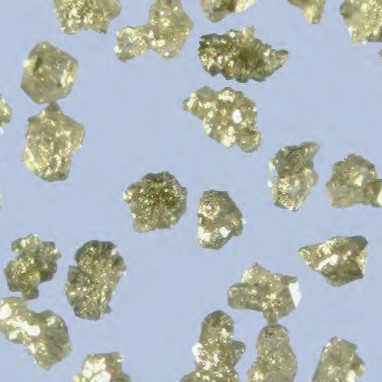
Controlled microfracturing
Suitable fracture behavior may expose fresh abrasive cutting edges; excessive breakage can increase wheel consumption.
SINODIAM INTERNATIONAL · INDUSTRIAL DIAMOND POWDERS
Friability-controlled RVG diamond grit for resin-bond precision grinding wheels.
Explore SND-R05, R10, R15 and R20 for different balances of grain fracture, self-sharpening behavior, abrasive integrity and grinding loads.
4 friability positions · RVG abrasive grit · Resin-bond wheel trials
WHY SINODIAM / SERIES OVERVIEW
Explore SND-R05, R10, R15 and R20 for different balances of grain fracture, self-sharpening behavior, abrasive integrity and grinding loads.
Suitable fracture behavior may expose fresh abrasive cutting edges; excessive breakage can increase wheel consumption.
R05, R10, R15 and R20 give initial friability selection positions without claiming a measured universal ranking.
Consider phenolic or polyimide resin, grain retention, diamond concentration and contact load together.
PRODUCT PORTFOLIO
Review each individual grade, its manufacturing application and relevant product-specific specifications before ordering.
PRODUCT 01 · MOST FRIABLE POSITION
Ultra-High Friability
A high-fracture-response grade for evaluating free-cutting precision grinding and low-force finishing behavior.
Selection focus: Active self-sharpening and low-force grinding
PRODUCT 02 · ECONOMY SEMI-BLOCKY
High Friability
Cost-conscious semi-blocky abrasive grains for general-purpose resin-bond grinding wheels.
Selection focus: General carbide, ceramic and glass grinding
PRODUCT 03 · STANDARD BLOCKY
Medium Friability
A balanced crystal position for evaluating both grain integrity and controlled renewal of cutting edges.
Selection focus: Balanced cutting and wear behavior
PRODUCT 04 · HIGHER TOUGHNESS POSITION*
Low Friability*
Positioned toward the tougher end of the series for higher-load grinding and form-retention trials.
Selection focus: Tougher grain and wheel wear management
TECHNICAL COMPARISON
Use this overview to shortlist a candidate material. Confirm actual batch data, particle-size specifications and the finished-tool process.
Friability is relative product positioning. *R20 toughness and morphology require grade-specific confirmation. A historical roughness or tool-life percentage is not a universal material performance guarantee.
INDUSTRIAL APPLICATIONS
The following are starting points for process evaluation, not guarantees of finished-tool performance.
Resin-bond wheels for sharpening and surface grinding carbide tooling.
Evaluate wheel loading, cutting force and crystal fracture response for suitable hard materials.
Match abrasive grading and bond hardness to brittle ceramic surface integrity.
Choose mesh size and wheel construction according to the desired edge and finish quality.
APPLICATION SELECTION GUIDE
Choose by workpiece, processing method and material formulation. Validate promising candidates under operating conditions.
STEP 01
Record carbide, cermet, ceramic or glass properties.
STEP 02
Choose removal rate, wheel life, finish and desired grinding force.
STEP 03
Start with the SND-R grade best matched to fracture and grain integrity.
STEP 04
Check resin binder, abrasive concentration, structure and mesh size.
STEP 05
Measure process stability, wheel wear, finish and cost per part.
TECHNICAL FAQ
Practical questions about grades, manufacturing compatibility, specifications and technical inquiries.
Friability describes the tendency of an abrasive grain to fracture under appropriate testing or operating conditions.
No. Grain fracture should be balanced with bond wear, cutting load and workpiece finish requirements.
R05 is positioned at the highly friable end; R20 is the comparatively tougher position. Confirm comparative behavior with product-specific tests.
Resin-bond grinding is the primary direction. Other bond systems require separate compatibility assessment.
The historical series range is approximately 60/70–325/400 mesh, but current availability must be confirmed per grade.
Share workpiece, wheel specifications, target mesh, finish, operating conditions, grade and estimated order quantity.
SINODIAM · TECHNICAL SUPPORT
Tell us your material grade or application, particle size, workpiece, bond or processing conditions, estimated quantity and destination country. SinoDiam can discuss available specifications and technical quotation options based on your requirements.
Request Technical Information & QuotationEmail: info@diamondmicron.com