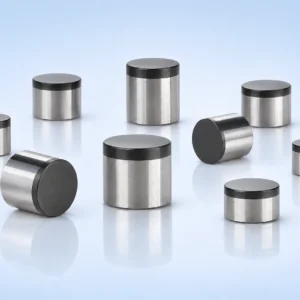

Geological & Mining PDC Cutters | 1308 Reference
SinoDiam geological mining PDC cutters are composite cutting elements for selected coalfield, geological exploration and rock-drilling tools. Start with the documented 1308 PDC cutter; confirm formation, face profile, dimensions and tool integration before ordering.
Product Overview
A polycrystalline diamond cutting table provides an abrasion-resistant rock-contact surface, supported by a cemented tungsten carbide substrate. The cutter is a component for a compatible drill-bit design, not a complete drill bit.
Select by rock abrasiveness, fracture and impact conditions, cutter exposure, edge shape and joining process. A nominal model code alone cannot predict drilling footage, rate of penetration or tool life.
1308 Reference Specification
The documented geological 1308 reference below is not a guaranteed batch specification. Request an approved drawing and current dimensional report.
| Parameter | Reference value |
|---|---|
| Model | 1308 |
| Outside diameter | Ø13.44 ±0.05 mm |
| Overall height | 8.0 ±0.1 mm |
| Diamond table thickness | 1.5–2.0 mm |
| Cutting layer | Polycrystalline diamond (PCD) |
| Supporting substrate | Cemented tungsten carbide |
| Profile / availability | Confirm flat or shaped profile, tolerances and current supply |
Reference specifications are for technical selection. No particular stock, tool life, field performance, thermal limit, certification or lead time is implied.
Cutter Construction & Interface
Polycrystalline diamond table
Abrasion-resistant rock-cutting face; assess thickness, edge integrity and wear under the intended formation.
Tungsten carbide substrate
Provides structural support and must suit the mounting and joining procedure of the complete bit.
Diamond–carbide interface
Examine bond integrity, residual stress and possible chipping or delamination during cutter qualification.
Edge and face design
Chamfer and contact profile affect local loads; confirm the actual drawing instead of assuming a standard shape.
Geological & Mining Applications
Typical applications are qualification candidates, not proof of suitability in every formation.
Coal mining PDC cutters
Candidates for compatible coalfield drill bits; consider coal seams, hard interlayers and impact.
Geological exploration
Assess lithology, drilling method, desired sample or borehole and bit design.
Mining rock drilling
Evaluate rotary cutting in suitable formations against abrasion, shock and tool geometry.
Roof bolting and anchor holes
Review compatible anchor-hole bits, mounting constraints and intermittent contact loads.
Geotechnical investigation
Match cutter shape and operating conditions to investigation and ground characteristics.
Specialized bit manufacturing
Discuss nonstandard dimensions and cutter arrangement with an engineering drawing.
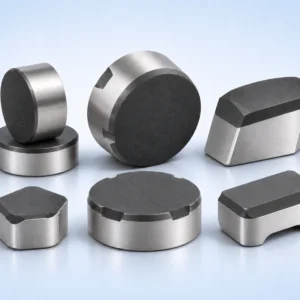
Cutting-Face Geometry Options
Face profiles are design options requiring drawing and manufacturing confirmation.
Flat face
Planar diamond cutting face for conventional compatible PDC bit structures.
Convex face
Curved profile changes initial rock contact; verify the specific curvature.
Helmet face
Contoured geometry requiring a dimensioned drawing and technical approval.
Ridge face
Raised ridge changes contact stress and cutting response; verify profile and application.
Half-cut type
Modified cutting element for particular installation or cutter placement; confirm exact shape.
Application-Based Cutter Selection
Choose the complete cutting system, not just a nominal diameter.
Formation abrasiveness
Assess quartz content and wear tendency, not only unconfined compressive strength.
Impact and vibration
Inspect expected shock, fractures and bit stability before choosing edge support.
Cutter geometry and size
Confirm diameter, height, diamond table and profile against the bit pocket.
Joining and operating conditions
Check attachment method, fluid/cooling, rotation and applied loading.
Qualification & Order Checklist
Compare samples with the same bit geometry and documented test conditions.
Dimensional inspection
Request drawing revision, diameter/height tolerances and diamond table data.
Tool-level testing
Compare wear, chipping, interface damage and drilling response under relevant conditions.
Purchase information
Share lithology, bit drawing, face profile, trial quantity, destination and schedule.
How the PDC Product Families Differ
| Product family | Product positioning | Confirm before ordering |
|---|---|---|
| Geological & Mining | 1308 reference and requested shape variants | Drilling formation, geometry and drawing |
| Oil & Gas GAS Series | Seven GAS model references | Model-specific diameter, height, diamond table and edge |
| Asphalt & Concrete Milling | Application-specific PDC cutting components | Mounting, abrasion and impact duty |
Explore Related PDC Products
Oil & Gas GAS Series
Review separate GAS cutter references for oilfield drilling-bit manufacturing.
Asphalt & Concrete Milling
Explore distinct PDC elements for selected milling and surface-processing tools.
Frequently Asked Questions
What is a geological mining PDC cutter?
A composite cutting element with a polycrystalline diamond table and carbide substrate, incorporated into a compatible drilling tool.
Is a PDC cutter a complete drill bit?
No. It is one cutting component; the finished bit has its own cutting structure and mounting design.
What is the documented 1308 diameter?
The SinoDiam reference lists Ø13.44 ±0.05 mm. Confirm the actual manufacturing drawing.
What is the documented 1308 height?
The listed overall height is 8.0 ±0.1 mm; agree on tolerances and measurement method.
How thick is the diamond table?
The reference lists 1.5–2.0 mm; request the approved range for the selected configuration.
Is 1308 the only available model?
No exclusive claim is made. Other sizes can be requested but availability requires confirmation.
Which cutter-face profiles are listed?
Flat, convex, helmet, ridge and half-cut are named as possible profiles, subject to drawing and manufacture.
Which profile works best in hard rock?
There is no universal choice. Compare rock strength, impact, abrasiveness, geometry and bit stability.
Can these cutters drill coal seams?
They can be evaluated for compatible coalfield bits; check hard interlayers and operating loads.
Are they suitable for geological exploration?
They may suit selected exploration methods when cutter design and formation conditions are compatible.
Can they be used in anchor drilling?
Only after reviewing the specific anchor-hole bit design, loading and cutter mounting.
Do they guarantee longer bit life?
No. Tool life depends on the rock, bit design, drilling parameters and qualification testing.
What causes cutter chipping?
Impact, vibration, edge geometry, formation transitions and assembly conditions may contribute.
How should abrasion be assessed?
Use representative formation tests and inspect wear flats, fracture and tool-level performance.
Can a custom geometry be supplied?
Submit an engineering drawing; feasibility, tolerances and lead time must be confirmed.
Is the 1308 data a stock guarantee?
No. It is a reference specification, not confirmation of present inventory or lot compliance.
What details are needed for a quotation?
Provide drilling application, rock description, dimensions, profile, bit drawing, quantity and delivery country.
How is this different from GAS cutters?
GAS is the separate oil-and-gas family with seven listed model references; geological/mining uses the 1308 reference and reviewed variants.
Technical Support & Request a Quotation
SinoDiam geological mining PDC cutters combine a polycrystalline diamond table with a cemented tungsten carbide substrate for selected coalfield, exploration and rock-drilling tools. The 1308 reference is Ø13.44 ±0.05 mm × 8.0 ±0.1 mm, with a 1.5–2.0 mm diamond table; confirm geometry and availability.