Product Overview
SND-G10 Standard Yellow Crushed RVD Diamond Grit is an industrial diamond abrasive in SinoDiam’s SND-G crushed diamond series. It is positioned as the standard yellow grade for manufacturers developing resin-bond grinding, polishing and stone-finishing tools.
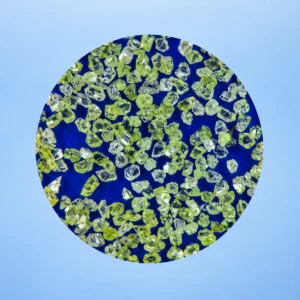
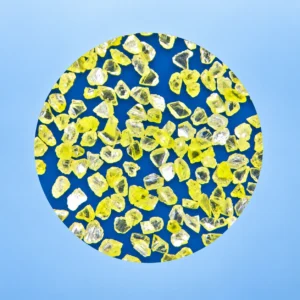
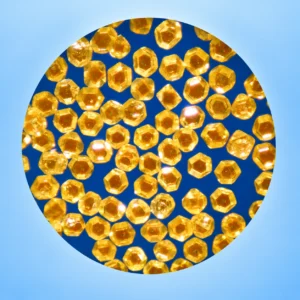
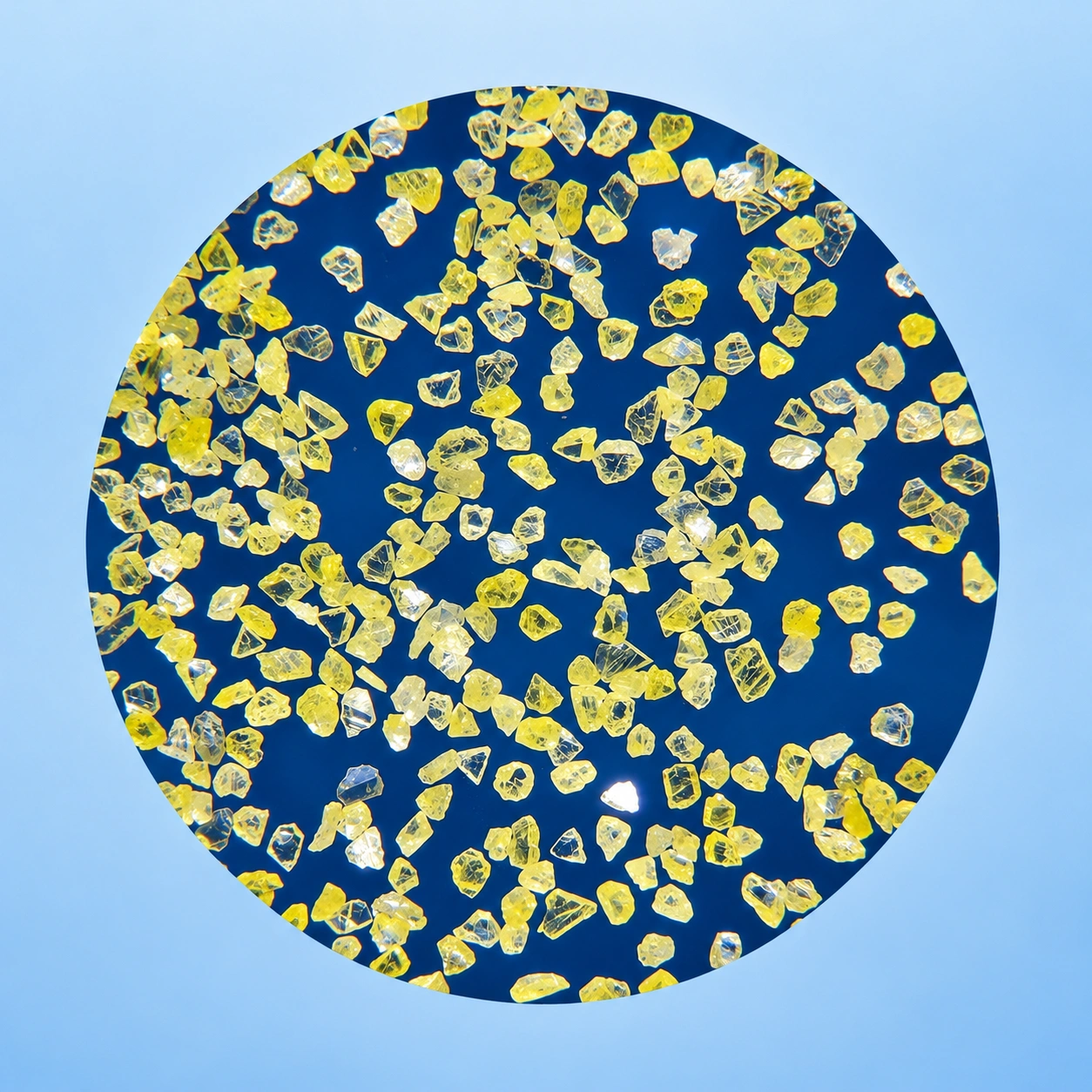
SND-G10 is characterized by its yellow color and irregular, angular crushed-grain morphology. Fractured diamond particles present multiple potential cutting edges that can contribute to abrasive cutting action when retained and exposed appropriately within a grinding or polishing tool.
The grade is intended primarily for evaluation in resin-bond polishing pads, grinding wheels and stone-processing abrasives used on marble, granite, quartzite and other suitable hard or brittle materials.
Within SinoDiam’s Crushed RVD portfolio, SND-G10 occupies the standard-grade position between SND-G05 Economy Green and SND-G15 Premium Yellow. This provides customers with a practical starting point for comparing abrasive performance, grain retention and tool economics across different grade choices.
Unlike general product claims based only on nominal hardness or color, selection of SND-G10 should consider particle-size distribution, crystal characteristics, bond formulation, grinding pressure, surface-finish requirements and the workpiece itself.
Contact SinoDiam for grade-specific mesh specifications, material documentation and assistance in evaluating SND-G10 against an existing crushed diamond abrasive.
Technical Specifications
The specifications above describe SND-G10’s current product positioning and intended applications. Individual mesh sizes, grading tolerances, feedstock documentation and comparative crystal-strength values should be confirmed using the relevant grade-specific technical records. No fixed surface-gloss, tool-life or efficiency improvement is guaranteed.
Crystal Characteristics & Grinding Behavior
Angular Crushed-Grain Geometry
The irregular particle shape provides a combination of angular contours, fractured surfaces and exposed edges. Grain geometry affects the way abrasive particles engage the workpiece and are retained in the bond system.
Multiple Potential Cutting Edges
Crushed diamond particles can present several cutting points rather than a single regular crystal face. Effective cutting depends on diamond exposure, bond retention, grain orientation and grinding conditions.
Fracture & Grain Retention
Suitable abrasive fracture may expose fresh cutting edges, while premature grain breakage or release can increase wheel wear. A balanced wheel design requires evaluation of the diamond grade and bonding matrix together.
Standard-Grade Application Position
SND-G10 is intended as a standard-series selection option for stone-processing abrasives where cutting action, finishing requirements, grain durability and overall tool economics must be considered together.
Recommended Applications
SND-G10 is positioned primarily for resin-bond grinding and polishing tools processing natural stone and other suitable hard-and-brittle materials. These are application targets for technical evaluation, not guaranteed results for all wheel designs.
Marble Grinding & Polishing
Evaluation in resin-bond stone-finishing abrasives for marble surface grinding, polishing stages and edge finishing. Grit size and bond formulation must be selected according to the stone characteristics and desired finish.
Granite Finishing Tools
A candidate for resin-bond grinding or polishing tool development where hard natural stone, abrasive cutting behavior, surface finish and tool wear need to be considered together.
Quartzite & Hard Stone Processing
For evaluation in selected stone-processing operations involving harder mineral surfaces. Toolmakers should assess grinding load, abrasive retention, removal rate and finish requirements under actual operating conditions.
Resin-Bond Polishing Pads
For manufacturers developing resin-bond diamond polishing pads and stone-finishing abrasives. Diamond grit, resin formulation, abrasive concentration and working sequence all influence finished-tool performance.
Resin-Bond Grinding Wheels
For selected bonded abrasive wheels used in grinding and finishing hard or brittle workpieces. Appropriate grain size, wheel hardness and grinding parameters should be determined through trials.
Specialized Ceramic & Glass Grinding
Selected ceramic and glass applications may be evaluated where the SND-G10 grain characteristics, particle size and tool formulation are appropriate. The required surface integrity and edge quality should guide selection.
SND-G10 is not automatically recommended for all hard-stone cutting blades, carbide machining or metal grinding. These applications require a separate assessment of the abrasive grade, bond system and workpiece.
Mesh Size Selection & Grading Requirements
For SND-G10 crushed RVD diamond grit, the correct particle size depends on the grinding or polishing operation, workpiece material, resin-bond construction and target surface quality. Grade-specific mesh availability should be confirmed before ordering.
How to Select a Grit Size
Coarser diamond grit: May be considered for earlier grinding or shaping stages when the workpiece and tool design permit higher material removal and a coarser abrasive contact pattern.
Intermediate diamond grit: Can be evaluated where cutting action, surface finish, wheel wear and overall polishing-process efficiency need to be balanced.
Finer diamond grit: May be suitable for later finishing stages, depending on the workpiece, pad formulation, abrasive exposure and required surface quality.
When comparing SND-G10 with another supplier’s crushed diamond grade, use the same mesh designation and grading standard wherever possible. The nominal mesh name alone may not fully describe the particle-size distribution.
Exact SND-G10 mesh fractions and particle-size limits require confirmation. The verified 80–500 mesh range for SND-G05 should not be assumed to apply automatically to SND-G10.
Bond Compatibility & Abrasive Tool Design
SND-G10 is positioned primarily for resin-bond stone grinding and polishing tools. Performance depends on the interaction between the diamond grit, bond matrix and working conditions rather than the abrasive grade alone.
Resin-Bond Polishing Tools
Primary application direction. Resin-bond polishing pads, abrasive blocks and selected grinding wheels can be evaluated using the required diamond grit size, resin formulation, abrasive concentration and tool geometry.
Bond Retention & Grain Exposure
The bonding matrix must retain abrasive grains sufficiently while providing appropriate exposure and cutting-edge renewal. Premature grain release, glazing and excess wear should be monitored during tool development.
Electroplated Diamond Tools
Separate technical validation required. Suitability depends on the plating process, particle geometry, diamond exposure, coating retention and application requirements.
Vitrified-Bond Grinding Tools
Separate technical validation required. Vitrified-bond formulations must account for bond chemistry, firing temperatures, diamond stability, grain retention and intended grinding behavior.
Do not interpret the potential for application trials as universal compatibility with every resin, electroplated or vitrified-bond system.
How to Compare SND-G10 with Other Yellow RVD Grits
For industrial buyers, the most useful comparison is based on measurable abrasive characteristics and the finished tool’s grinding results rather than unsupported claims about gloss, purity or percentage improvements.
| Comparison Item | What to Compare | Why It Matters |
|---|---|---|
| Particle Size | Mesh fraction, grading standard and size distribution | Controls abrasive contact and finish requirements |
| Crystal Morphology | Angular shape, fracture surfaces and grain-size consistency | Influences cutting action and bond retention |
| Crystal Strength | Comparable strength or friability test results, where available | Supports selection under the intended grinding load |
| Bond Compatibility | Resin formulation, concentration and abrasive exposure | Affects wheel behavior and grain retention |
| Grinding Results | Material removal, surface finish, wheel wear and cost per part | Shows performance in the intended tool and workpiece |
This table lists recommended evaluation criteria. It does not imply that measured values or direct competitor-grade equivalences have already been established for SND-G10.
Crushed RVD vs. Resin Bond RVG Diamond
Crushed RVD and resin-bond RVG diamond abrasives can both be considered for selected bonded grinding applications. However, SinoDiam organizes its Crushed RVD grades primarily by crushed-grain characteristics and series positioning, while its SND-R RVG series emphasizes relative friability and self-sharpening behavior.
| Diamond Series | Selection Focus | Typical Application Direction |
|---|---|---|
| Crushed RVD / SND-G10 | Angular crushed-grain morphology; standard-grade stone-processing applications | Resin-bond grinding and polishing tools |
| Resin Bond RVG / SND-R | Friability, grain fracture and self-sharpening behavior | Precision resin-bond grinding wheels |
| Metal Bond Mesh / SND-G20–G60 | Crystal toughness and grain behavior in metal-bond tools | Selected cutting, grinding and drilling applications |
The categories are selection frameworks rather than mutually exclusive uses. Equivalent-grade decisions require technical documentation and application trials.
SinoDiam Crushed RVD Grade Selection
Compare SND-G05, SND-G10 and SND-G15 according to product positioning, particle characteristics, the intended bond system and workpiece requirements. Grade names alone do not establish measured strength rankings or direct cross-brand equivalence.
SND-G05, SND-G10 and SND-G15 are separate product grades. Their exact mesh ranges, crystal properties and application suitability must be compared using grade-specific documentation and, where possible, equivalent grinding tests.
Frequently Asked Questions
1. What is SND-G10 yellow crushed RVD diamond grit?
2. What is the difference between SND-G05 and SND-G10?
3. How does SND-G10 compare with SND-G15?
4. Is SND-G10 suitable for resin-bond polishing pads?
5. Which stones can SND-G10 be used to process?
6. Does yellow crushed diamond grit guarantee a mirror finish?
7. What mesh sizes are available for SND-G10?
8. Is SND-G10 equivalent to ZND2110?
9. Is SND-G10 suitable for vitrified or electroplated tools?
10. How is crushed RVD different from resin-bond RVG diamond?
11. Can SND-G10 replace an existing yellow RVD grade from another manufacturer?
12. What information is needed for an SND-G10 quotation?
SINODIAM INTERNATIONAL · INDUSTRIAL DIAMOND MATERIALS
Request SND-G10 Technical Specifications & Quotation
Looking for standard yellow crushed RVD diamond grit for resin-bond stone grinding, marble or granite polishing, or industrial abrasive-tool manufacturing?
Tell us your workpiece, required mesh size, grinding or polishing stage, bond formulation, estimated quantity and delivery destination. SinoDiam can discuss available SND-G10 technical specifications and application-based grade selection.
For grade replacement inquiries, please include the current supplier model and any available particle-size or grinding-performance information.