Product Overview
SND-G05 Economy Green Synthetic Crushed RVD Diamond Grit is an industrial abrasive manufactured from synthetic diamond feedstock. It belongs to SinoDiam’s SND-G crushed RVD series and is positioned as an economy-grade material for resin-bond grinding, edging and polishing tool manufacturing.
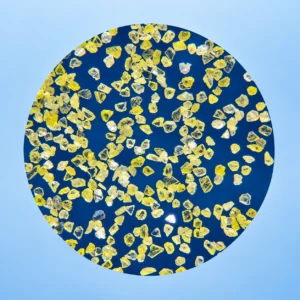
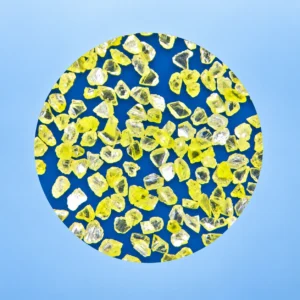
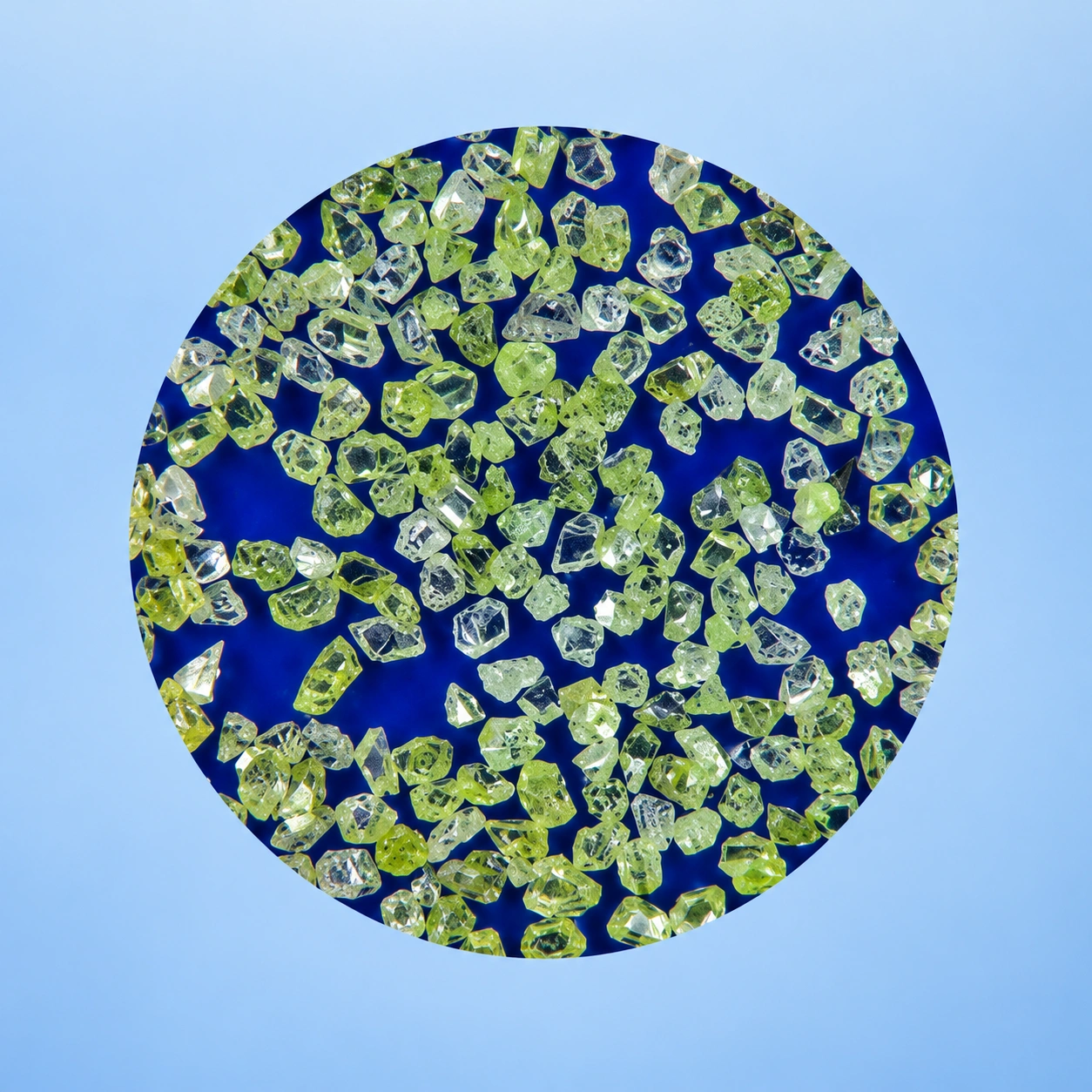
SND-G05 features irregular, angular crushed diamond particles with multiple potential cutting edges. These fractured grain surfaces are relevant to abrasive cutting action, particle retention and grinding behavior when the diamond grit is incorporated into a suitable bonded tool.
Available in the 80–500 mesh range, SND-G05 offers particle-size options for different grinding and finishing requirements. Individual mesh fractions and particle-size distributions should be confirmed according to the customer’s grading standard and application.
The primary application direction is resin-bond abrasive tools used for stone grinding, ceramic tile edging, glass chamfering and selected hard-and-brittle material processing.
Electroplated and vitrified-bond applications may be evaluated separately. Their suitability depends on the specific tool construction, bond system, manufacturing process and application testing.
As an economy-grade synthetic diamond abrasive, SND-G05 is intended for manufacturers evaluating the balance between abrasive material cost, cutting behavior, tool wear and finished-part quality.
Technical Specifications
SND-G05
Crushed RVD Diamond Grit
Synthetic Diamond
Synthetic Diamond Feedstock
Economy Grade
Green
Irregular / Angular Crushed Grains
Mesh-Size Diamond Abrasive
80–500 Mesh
Confirm by Required Specification
Resin Bond
Electroplated / Vitrified – Trial Required
Grinding / Edging / Polishing Tools
Stone / Ceramic / Glass
SND-G05 is manufactured from synthetic diamond and is offered in the 80–500 mesh range. Confirm the required individual mesh fraction, grading standard, particle-size distribution and order specification before production use. Resin bond is the primary application system. Electroplated and vitrified-bond compatibility must be validated for the specific tool and manufacturing process.
Crystal Characteristics & Cutting Behavior
Irregular, Angular Crystal Morphology
SND-G05 consists of crushed synthetic diamond grains with irregular outlines and fractured surfaces. The angular morphology is an important factor when selecting diamond abrasives for bonded grinding and finishing tools.
Multiple Potential Cutting Edges
The fractured particle geometry provides multiple potential abrasive cutting edges. Actual cutting action depends on grain orientation, particle exposure, bond retention, workpiece characteristics and grinding conditions.
Abrasive Grain Fracture Behavior
Individual crushed diamond grains may undergo additional localized fracture under suitable grinding loads. Such fracture can expose new cutting edges, but the response depends on grain strength and the complete abrasive-tool design.
Economy-Grade Tool Formulation
SND-G05 is positioned for cost-conscious grinding-wheel and abrasive-tool manufacturing. Tool performance should be evaluated through cutting efficiency, workpiece finish, abrasive consumption and cost per finished component.
Recommended Applications
SND-G05 is primarily intended for evaluation in resin-bond abrasive tools used on stone, ceramics, glass and selected hard-and-brittle materials. Final suitability depends on grit size, bond formulation, workpiece properties and operating conditions.
Stone Grinding & Edge Processing
For evaluation in resin-bond diamond tools used for stone surface grinding, edge shaping and selected finishing operations. Stone type, grinding pressure, abrasive size and tool construction are important selection factors.
Ceramic Tile Edging
For resin-bond abrasive-tool development involving ceramic tile edge grinding, chamfering and finishing. Grit size and wheel formulation should be matched to edge-chipping control, removal requirements and surface quality.
Glass Chamfering & Edge Grinding
For evaluation in selected glass chamfering, edge shaping and grinding operations. Diamond particle size, bond hardness, abrasive exposure and grinding conditions influence achievable edge quality.
Resin-Bond Abrasive Tools
Designed primarily for manufacturers of resin-bond grinding wheels and related abrasive products where angular synthetic diamond grit, particle-size selection and overall tool economics are important.
Electroplated Tool Evaluation
SND-G05 may be assessed for specific electroplated diamond tools. Evaluation should consider grain shape, nickel-plating conditions, abrasive exposure, retention in the plated layer and actual tool performance.
Specialized Grinding & Finishing
Selected hard-and-brittle materials may be evaluated where the abrasive particle size, angular grain characteristics and bonded-tool design are suitable for the required grinding or finishing operation.
These are application-selection directions rather than guaranteed results for every material or tool construction. Application-specific grinding and tool-manufacturing trials are recommended.
Available Mesh Sizes & Grit Selection
SinoDiam SND-G05 green synthetic crushed diamond grit is available in the 80–500 mesh range. This provides a basis for selecting abrasive particle sizes according to the grinding stage, workpiece material, resin-bond formulation and required surface finish.
The available product range is 80–500 mesh. The individual mesh fraction, grading standard and particle-size distribution must be specified and confirmed for each inquiry. The range does not mean every possible intermediate mesh designation is necessarily supplied.
How Grit Size Influences Grinding
Coarser grit: May be selected for greater material removal or initial shaping where the workpiece and abrasive-tool construction permit a larger particle size.
Intermediate grit: Can be evaluated where material removal, abrasive wear, edge quality and finishing requirements must be balanced.
Finer grit: May be selected for controlled grinding, edging and surface-finishing stages where smaller cutting points and improved finish are priorities.
Grit size alone does not guarantee a specific removal rate, surface roughness or tool life. The complete abrasive system must be considered.
For a technical inquiry, please specify the required mesh size, relevant grading standard, target workpiece material, tool type, bond system and expected quantity.
Bond Compatibility & Tool Manufacturing
The selection of crushed synthetic diamond grit depends on particle morphology, the bonding matrix, abrasive concentration, grain retention and manufacturing conditions.
Resin-Bond Grinding Tools
Primary application direction. SND-G05 is intended mainly for resin-bond grinding, edging and polishing tools. Resin formulation, bond hardness, grain concentration and manufacturing conditions should be matched to the required workpiece and operation.
Electroplated Diamond Tools
Application-specific validation required. Potential suitability depends on the plating system, diamond surface characteristics, particle exposure, nickel-layer retention and the intended mechanical operating conditions.
Vitrified-Bond Tools
Application-specific validation required. Bond composition, firing temperature, crystal stability, abrasive retention and intended grinding behavior must be reviewed before production use.
Tool Performance Evaluation
Compare candidate abrasive formulations using cutting action, material removal rate, edge quality, surface finish, bond retention, abrasive consumption and overall manufacturing cost.
Resin bond is the current primary application system for SND-G05. Electroplated and vitrified-bond systems are not universally compatible and require specific tool trials.
Crushed RVD vs. Other Diamond Grit Types
Industrial diamond abrasives are often compared by particle morphology, toughness, friability, grit size and intended tool construction. Crushed RVD, resin-bond RVG and saw-grit diamonds may have overlapping applications, but their technical selection priorities are not identical.
| Diamond Type | Key Selection Characteristics | Typical Tool Applications |
|---|---|---|
| Crushed RVD / SND-G05 | Angular crushed synthetic diamond particles; economy-grade positioning | Selected resin-bond grinding, edging and polishing tools |
| Resin Bond RVG / SND-R Series | Friability, grain fracture and controlled self-sharpening behavior | Precision resin-bond grinding wheels and related tools |
| Saw Grit / SND Series | Crystal toughness, shape and cutting-load resistance | Diamond saw-blade segments, drilling tools and cutting applications |
This table provides general product-selection guidance. The categories are not mutually exclusive, and direct grade substitution requires comparison of actual crystal specifications and tool performance.
SinoDiam Crushed RVD Grade Selection
SinoDiam’s SND-G crushed RVD series includes three principal product grades. Each should be selected according to abrasive characteristics, workpiece material, particle size, bond system and expected grinding performance.
Economy, Standard and Premium describe SinoDiam’s product-grade positioning. These terms do not establish direct equivalence with competitors’ products or guarantee a particular increase in grinding efficiency, abrasive strength or tool life. Individual specifications for SND-G10 and SND-G15 should be reviewed separately.
Frequently Asked Questions
1. What is SND-G05 crushed RVD diamond grit?
2. Is SND-G05 made from synthetic or natural diamond?
3. What mesh sizes are available for SND-G05?
4. What are the main characteristics of crushed RVD diamond?
5. How is crushed RVD different from resin-bond RVG diamond?
6. Which bond system is recommended for SND-G05?
7. Can SND-G05 be used in electroplated or vitrified-bond tools?
8. What materials can SND-G05 be used to grind?
9. What is the difference between SND-G05, SND-G10 and SND-G15?
10. Is SND-G05 suitable for heavy-duty diamond saw blades?
11. Does SND-G05 guarantee longer tool life or lower grinding costs?
12. How can SND-G05 be compared with another supplier’s crushed diamond grit?
13. What information should I provide when requesting a quotation?
SINODIAM INTERNATIONAL · SYNTHETIC INDUSTRIAL DIAMOND
Request SND-G05 Technical Specifications & Quotation
Looking for economy-grade green synthetic crushed RVD diamond grit for resin-bond grinding, stone processing, ceramic edging or glass chamfering?
SND-G05 is available in the 80–500 mesh range and is primarily intended for resin-bond abrasive-tool applications. Electroplated and vitrified-bond suitability can be discussed according to the specific tool and manufacturing conditions.
Send us your desired mesh fraction, grading standard, workpiece material, bond system, tool design, estimated quantity and destination country. SinoDiam can review your requirements and discuss available technical specifications.