
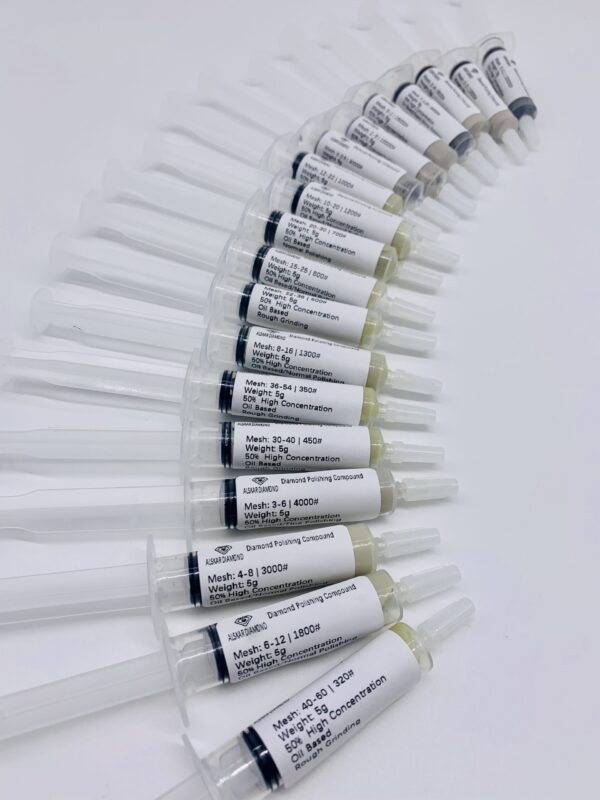
Product Overview
SinoDiam SND220 Water-Soluble Diamond Compound is an industrial synthetic diamond polishing paste designed for manufacturers and laboratories evaluating precision lapping, metallographic specimen preparation, technical ceramic finishing and other suitable polishing applications.
SND220 combines synthetic diamond micron abrasive particles with a water-soluble or water-compatible carrier system. This carrier provides a medium for distributing diamond particles across the polishing interface and supports selected processes where water-based handling and cleanup are preferred over oil-based compounds.
The diamond particles provide the abrasive action, while the carrier influences distribution, handling, application and post-polishing cleaning. Effective performance depends on diamond particle size, particle-size distribution, abrasive concentration, carrier formulation, polishing medium and workpiece characteristics.
Primary evaluation directions include metallographic cross-section preparation, engineering ceramic lapping, precision hard-material finishing, laboratory specimen polishing and selected electronic-component sample preparation.
For metallographic polishing, the diamond micron size, polishing cloth, applied pressure, lubricant or extender and cleaning procedure should be matched to the specimen material and inspection requirements. Improper abrasive selection can produce scratches, abrasive embedding, particle pull-out or other preparation artifacts.
The designation water-soluble describes the compound’s carrier characteristics. The diamond particles themselves remain insoluble solids. Water-based cleanup does not automatically remove all abrasive particles, additives or other process residues.
Water compatibility must also be evaluated against the workpiece. Some metals, coatings and electronic materials may be sensitive to moisture, corrosion, staining or specific formulation ingredients.
SND220 is intended for selected polishing and sample-preparation applications. Direct semiconductor wafer processing, cleanroom use and strict low-contamination manufacturing require additional product-specific qualification and should not be inferred from the water-soluble designation.
The historical SinoDiam product catalogue describes multiple micron sizes, diamond concentration levels and packaging formats. Current available particle-size fractions, diamond loading, carrier specifications and packaging should be confirmed before ordering.
For technical selection, please provide the workpiece or specimen material, polishing method, required micron size, target surface quality, cleaning requirements, estimated quantity and delivery destination.
Technical Specifications
SND220 is the confirmed SinoDiam water-soluble diamond compound model. The historical catalogue describes various micron sizes and concentration levels; current availability and numerical specifications require confirmation. No universal particle-size tolerance, diamond concentration, scratch-free finish, cleaning-time reduction or shelf life is guaranteed by this description.
Water-Soluble Carrier Technology & Polishing Performance
The polishing compound carrier influences abrasive distribution, handling and post-processing. SND220 is intended for applications where a water-compatible diamond compound is appropriate for the workpiece, polishing medium and cleaning workflow.
Water-Compatible Formulation
The SND220 carrier is designed for water-compatible handling and polishing. Actual dilution behavior, viscosity and approved extenders depend on the current formulation and should be confirmed before use.
Synthetic Diamond Micron Particles
Diamond particle size, morphology and distribution influence abrasive engagement. Select the micron fraction according to the specimen, required material removal and surface-quality target.
Dispersion & Particle Stability
Carrier properties and diamond concentration affect how particles are distributed during polishing. Agglomeration, settling or contamination may influence the effective abrasive contact size.
Scratch & Artifact Control
Appropriate particle-size selection and cleanliness are important for precision specimen preparation. The compound alone cannot guarantee a scratch-free surface or eliminate preparation artifacts.
Water-Based Cleanup Evaluation
Water-compatible carriers may be useful in polishing workflows that favor water-based cleaning. Actual residue removal depends on carrier additives, remaining abrasive particles and the cleaning procedure.
Workpiece & Corrosion Considerations
Water exposure and formulation chemistry may affect sensitive metals, coatings and electronic components. Verify specimen compatibility and appropriate drying or protection procedures.
Important: Water-Soluble Does Not Mean Residue-Free
The water-compatible carrier and diamond abrasive are different components. Diamond particles remain solid after the carrier is rinsed away. For sensitive polishing processes, establish appropriate particle-removal, rinsing, drying and inspection procedures. Cleanroom or low-contamination claims require separate qualification.
Diamond Micron Size Selection for Precision Polishing
Diamond particle size should be selected around the specimen material, previous grinding stage, polishing equipment and final surface requirement. The following size windows are general technical examples and are not a guaranteed list of SND220 stock specifications.
Fine Polishing0.25–3 µm
Evaluate finer diamond particles for suitable late-stage polishing and surface refinement. Oversized grains, agglomeration and cleanliness may be important where inspection requirements are demanding.
Intermediate Preparation3–15 µm
Consider intermediate fractions for selected specimen lapping and polishing processes where controlled material removal and surface quality must be balanced.
Coarser Preparation15–50 µm
Evaluate coarser micron fractions for suitable earlier preparation stages. Confirm possible subsurface damage, abrasive engagement and the need for subsequent finer polishing.
Important Size-Specification Factors
Nominal Size vs. D50
A nominal micron designation does not automatically equal a measured median particle size. Confirm the applicable size classification, measurement method and specification limits.
D10 / D50 / D90
Particle-size distribution data help describe a powder population. Comparisons should use compatible measurement methods and distribution bases.
Oversize Particle Control
Rare larger particles may cause isolated scratches in sensitive finishing applications. D90 alone may not adequately establish an acceptable oversize limit.
Multi-Stage Polishing
Some specimens require successive preparation stages using different abrasive sizes. Select the sequence according to initial surface condition and final inspection requirements.
How Should the Correct Micron Size Be Selected?
Start with the workpiece and processing stage, then define the required particle-size distribution and finishing target. Where possible, compare candidate SND220 fractions under controlled polishing conditions using representative specimens.
The size ranges shown above illustrate application directions. They do not establish the exact current SND220 size list, abrasive loading or guaranteed finishing results.
Read the SinoDiam Diamond Micron Powder Size Selection Guide →
Diamond Concentration, Dispersion & Packaging
Diamond loading influences the amount of abrasive available at the polishing interface. The appropriate concentration depends on particle size, carrier characteristics, polishing cloth or lap and the intended processing stage.
Light
Lower diamond loading may be evaluated for selected finishing operations requiring controlled abrasive contact. Actual concentration and availability must be confirmed.
Medium
Intermediate loading may be considered where material removal, abrasive distribution and process control need to be balanced. The appropriate specification depends on the application.
Heavy
Higher diamond loading may be considered for selected removal-oriented preparations. Increased concentration does not automatically provide a faster process or better final surface finish.
How Is Diamond Concentration Defined?
Depending on the compound formulation, diamond loading may be described by weight fraction, abrasive mass per package, carat content or manufacturer-defined concentration grades. These reporting methods are not directly interchangeable without corresponding specifications.
Water-Compatible Dispersion
Particle size, diamond loading, carrier viscosity and mixing conditions influence dispersion. The formulation should provide suitable handling and abrasive distribution for the intended polishing method.
Packaging & Dispensing Options
SinoDiam’s historical product information references syringe, tube and jar packaging. Confirm the currently available package size, net compound weight, diamond content and dispensing configuration before ordering.
Storage & Product Handling
Use the storage instructions provided with the actual SND220 formulation. Keep the compound protected from contamination and follow the applicable product label and Safety Data Sheet for storage, handling and shelf-life requirements.
Light, Medium and Heavy are formulation categories, not universal numerical concentration standards. No fixed diamond percentage, packaging size or shelf life is established without product-specific documentation.
Recommended Applications of SND220 Diamond Compound
SND220 is positioned for selected specimen-preparation and precision-polishing processes where synthetic diamond abrasive and a water-compatible carrier are appropriate. The workpiece, polishing medium and cleaning requirements determine suitability.
Metallographic Specimen Preparation
Evaluate SND220 for selected metallographic grinding and polishing sequences, including material cross-section preparation. Diamond size, polishing cloth, applied load and possible preparation artifacts should be considered together.
R&D Laboratory Polishing
For suitable laboratory specimens requiring controlled surface preparation. Define the specimen material, abrasive stage, inspection method and appropriate cleanup procedure.
Technical Ceramic Finishing
Selected engineering ceramics may be candidates for diamond polishing. Particle size, workpiece brittleness, surface damage and polishing conditions require application-specific testing.
Electronic Component Cross-Sections
Evaluate for appropriate laboratory cross-section polishing of electronic components or packages. Control particle embedding, scratches, residue and contamination relevant to the inspection method.
Glass & Hard-Material Lapping
For selected glass, mineral and hard-material specimens where diamond is an appropriate abrasive. Verify water compatibility and the selected polishing medium before use.
Precision Component Polishing
Suitable precision components may require controlled abrasive finishing and cleaning. Evaluate surface roughness, local damage, particle retention and process repeatability using representative parts.
These are potential application directions, not universal approvals. For hardened ferrous workpieces, an alternative abrasive such as CBN may be appropriate. Direct semiconductor wafer production and cleanroom applications require separate material and contamination qualification.
How to Select & Apply SND220 Water-Soluble Diamond Compound
Develop the polishing process according to the specimen material, abrasive grade, polishing medium and inspection requirements. The following steps provide a practical selection framework rather than a fixed operating procedure.
Identify the Workpiece
Confirm the specimen material, initial surface condition, water sensitivity, corrosion risk and final inspection criteria. Ensure diamond is an appropriate abrasive for the material.
Select the Diamond Size
Specify the required micron fraction, PSD and abrasive grade. Match the selected size to the previous preparation stage and target surface condition.
Match the Polishing Medium
Confirm compatibility with the polishing cloth, lap or applicator. Use an approved lubricant or extender where required by the actual SND220 formulation.
Validate Surface & Cleanup
Evaluate scratches, embedded abrasives, surface damage and residue after suitable rinsing and drying. Adjust the abrasive size, pressure or preparation sequence if necessary.
Laboratory Handling & Cleaning Considerations
Prevent contamination between abrasive-size stages by using clean polishing equipment and appropriate cleaning procedures. Water-sensitive materials may require controlled drying or additional protection. Storage, personal protection and disposal requirements should follow the current product label and applicable Safety Data Sheet.
SND220 Water-Soluble vs. SND210 Oil-Soluble Diamond Compound
SinoDiam’s two diamond polishing compound products use different carrier approaches. Select the product according to the workpiece, lubrication and polishing requirements, available equipment and cleaning workflow.
| Selection Factor | SND220 Water-Soluble | SND210 Oil-Soluble |
|---|---|---|
| Carrier System | Water-soluble / water-compatible formulation | Oil-based / oil-compatible formulation |
| Primary Application Direction | Metallographic preparation, laboratory polishing and selected precision applications | Mold and die finishing, carbide polishing and selected toolroom applications |
| Polishing Medium | Evaluate with water-compatible polishing media and approved extenders | Evaluate with oil-compatible polishing media and approved extenders |
| Cleaning Process | Water-based cleanup may be suitable; residual particles require attention | Oil-compound cleanup requires compatible cleaning methods |
| Workpiece Compatibility | Check water sensitivity, corrosion and formulation chemistry | Check oil residue, carrier interaction and cleaning requirements |
| Diamond Micron Size | Confirm available fractions and PSD | Confirm available fractions and PSD |
| Diamond Concentration | Confirm actual diamond loading | Confirm actual diamond loading |
| Finished Surface Quality | Determine through representative polishing trials | Determine through representative polishing trials |
SND220 and SND210 differ in carrier type, not by a universal ranking of polishing quality. Actual cleaning behavior, lubrication, abrasive specifications and surface finish depend on the selected compound formulation and process.
SinoDiam Diamond Compound Paste Selection
Choose the appropriate diamond compound according to workpiece compatibility, abrasive particle size, carrier requirements and polishing process.
SND220 Water-Soluble Diamond Compound
Synthetic diamond polishing paste with a water-compatible carrier for selected metallographic specimen preparation, laboratory lapping and precision finishing applications.
Selection focus: Micron size, particle-size distribution, specimen compatibility, dispersion and water-based cleanup requirements.
SND210 Oil-Soluble Diamond Compound →
Oil-based synthetic diamond polishing paste for suitable carbide drawing dies, mold finishing and precision toolroom applications.
Selection focus: Diamond size, abrasive concentration, oil-carrier compatibility and polishing conditions.
Frequently Asked Questions — SND220 Diamond Compound
1. What is SND220 Water-Soluble Diamond Compound?
SND220 is SinoDiam’s water-soluble diamond polishing compound for selected metallographic specimen preparation, precision lapping and hard-material polishing. The correct micron size, abrasive concentration and carrier conditions should be selected for the intended application.
2. What is the official product code for SinoDiam water-soluble diamond compound?
The product code is SND220. It identifies SinoDiam’s water-soluble diamond compound product within the Diamond Compound Pastes family.
3. Do the diamond particles dissolve in water?
No. The water-soluble designation applies to the carrier system. Diamond particles are solid abrasives and remain insoluble. Suitable cleaning is needed to remove abrasive particles and polishing residues.
4. Is SND220 guaranteed to be petroleum-free?
The precise carrier ingredients must be established from current formulation documentation. A water-soluble designation alone does not verify a petroleum-free or solvent-free composition.
5. Is SND220 suitable for metallographic specimen preparation?
Metallographic polishing is a primary evaluation direction. Particle size, polishing cloth, pressure, specimen material and inspection requirements should be matched to the actual preparation process.
6. Can SND220 be used for electronic component cross-sections?
Selected laboratory cross-section preparation applications may be evaluated. Control scratches, embedded abrasive particles, residue and contamination according to the component and inspection method.
7. Is SND220 qualified for semiconductor wafer manufacturing?
No semiconductor wafer production or cleanroom qualification is established by this product description. Such processes require separate validation of particles, carrier chemistry, contamination, surface damage and other application-specific requirements.
8. Does SND220 guarantee residue-free polishing?
No. A water-compatible carrier may support certain cleaning workflows, but diamond particles, additives and polishing debris can remain. Appropriate rinsing, drying and inspection procedures should be used.
9. Can SND220 be used on all metals and ceramics?
No. Workpieces vary in hardness, water sensitivity, corrosion behavior and response to diamond abrasives. Material and carrier compatibility must be evaluated for the specific application.
10. What diamond micron sizes are available for SND220?
The historical SinoDiam catalogue describes multiple micron fractions, including a broad range extending to 70 µm. Current availability, grading limits and diamond types must be confirmed for the requested specification.
11. How should I select the diamond concentration?
Selection depends on the specimen, particle size, polishing cloth, carrier and processing stage. Light, Medium and Heavy are possible formulation categories whose actual diamond content must be confirmed before ordering.
12. Can SND220 be diluted with water?
Water compatibility does not establish an unrestricted dilution ratio. Use the current product instructions or request confirmation of approved diluents, extenders and working concentrations.
13. How does SND220 differ from SND210?
SND220 uses a water-soluble or water-compatible carrier, while SND210 is oil-soluble. Both are diamond compounds, but their handling, polishing-media compatibility and cleaning requirements may differ. Select according to the complete application.
14. Can SND220 be mixed with SND210 oil-soluble compound?
Do not assume the carrier systems are compatible. Mixing different compounds may affect dispersion, viscosity and polishing behavior. Obtain formulation-specific guidance before mixing products.
15. Does SND220 guarantee scratch-free polishing?
No. Scratches may result from oversized diamond particles, contamination, unsuitable polishing media, improper pressure or workpiece characteristics. Surface quality must be verified through appropriate testing.
16. What packaging options are available?
Historical product information refers to syringes, tubes and jars. Current package sizes, net compound weight and available concentrations must be confirmed before ordering.
17. How should SND220 be stored?
Follow the current product label and applicable Safety Data Sheet. Keep the compound protected from contamination and observe the specified storage conditions and shelf life for the actual formulation.
18. Is CBN paste included in the standard SND220 formulation?
No CBN content should be assumed. SND220 is presented here as a synthetic diamond compound. Any CBN-based formulation should be confirmed as a separate available specification.
19. What tests are useful for qualifying SND220?
Relevant testing may include particle-size distribution, diamond loading, dispersion, polishing removal behavior, surface roughness, scratch inspection, residue and cleaning assessment, and workpiece compatibility under defined conditions.
20. What information is required for an SND220 quotation?
Please provide the workpiece or specimen material, polishing method, required micron fraction, diamond concentration requirements, water compatibility, cleaning needs, packaging preference, expected quantity and delivery destination.
SINODIAM INTERNATIONAL · SND220 DIAMOND COMPOUND TECHNICAL SUPPORT
Request SND220 Water-Soluble Diamond Compound Specifications & Quotation
Looking for a water-soluble synthetic diamond polishing compound for metallographic specimen preparation, technical ceramic finishing, laboratory lapping or selected precision-polishing applications?
Share your workpiece or specimen material, polishing process, required diamond micron size, abrasive concentration, carrier and cleaning requirements, surface-quality target, estimated order quantity and delivery destination.
SinoDiam can discuss the current SND220 specifications and technical information required to evaluate abrasive size, diamond loading, water compatibility, polishing performance and post-process cleaning.
