
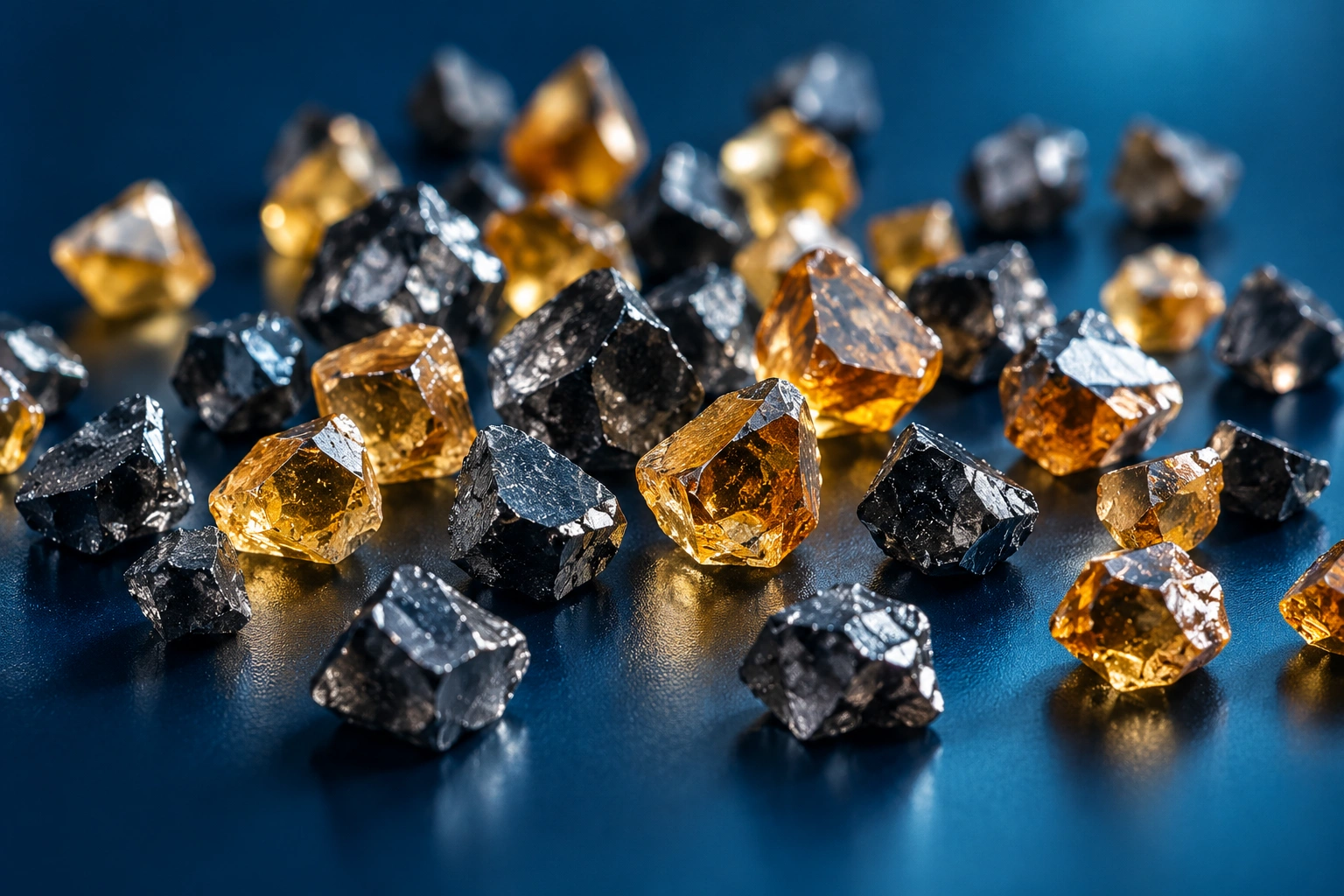
CBN for ferrous workpieces
CBN abrasive is often a relevant choice for hardened steel, tool steel, suitable cast iron and other ferrous grinding applications.
SINODIAM INTERNATIONAL · ADVANCED SUPERABRASIVES
Four CBN abrasive grades for grinding hardened steel and other suitable ferrous materials.
Explore amber and black CBN crystals selected according to morphology, fracture behavior, bond system and grinding load. CBN abrasive grit is distinct from consolidated PCBN cutting material.
4 CBN grades · Ferrous-metal grinding · Resin · Vitrified · Metal
WHY SINODIAM / SERIES OVERVIEW
Explore amber and black CBN crystals selected according to morphology, fracture behavior, bond system and grinding load. CBN abrasive grit is distinct from consolidated PCBN cutting material.
CBN abrasive is often a relevant choice for hardened steel, tool steel, suitable cast iron and other ferrous grinding applications.
Amber irregular, amber regular, black friable and bright black blocky positions support different grinding-wheel needs.
Resin, vitrified, metal and electroplated tool manufacturing require different grain retention and thermal-process considerations.
PRODUCT PORTFOLIO
Review each individual grade, its manufacturing application and relevant product-specific specifications before ordering.
PRODUCT 01 · RESIN-BOND FOCUS
Amber Irregular
Irregular amber CBN grit positioned for resin-bond wheel formulations and controlled cutting-edge renewal.
Selection focus: General ferrous-metal grinding
PRODUCT 02 · MULTI-BOND EVALUATION
Amber Regular
More regular amber CBN crystals for selected vitrified, metal and electroplated abrasive-tool systems.
Selection focus: Multi-bond toolmaking
PRODUCT 03 · RESIN-BOND FOCUS
Black Friable
Black, relatively friable CBN grit for fine ferrous-metal grinding where grain fracture and free-cutting behavior are relevant.
Selection focus: Precision resin-bond grinding
PRODUCT 04 · HIGHER GRAIN INTEGRITY
Bright Black Blocky
Bright black blocky CBN abrasive for demanding ferrous-material grinding and higher-load tool evaluation.
Selection focus: Vitrified, metal and plated trials
Live product URL retains historical cnb-b20 slug
TECHNICAL COMPARISON
Use this overview to shortlist a candidate material. Confirm actual batch data, particle-size specifications and the finished-tool process.
CBN grade suitability depends on actual crystal characteristics, grit size, tool bond, operating speed and workpiece. Historical 1300°C, 8000 RPM, fixed Ra and tool-life percentages should not be treated as universal guarantees.
INDUSTRIAL APPLICATIONS
The following are starting points for process evaluation, not guarantees of finished-tool performance.
Compare CBN grades for suitable hardened steel tools and components.
Select abrasive structure and bond based on grinding operation and workpiece heat treatment.
Assess cutability, wheel wear and surface objectives for selected ferrous materials.
Review grain durability and firing compatibility.
Evaluate friability, bond hardness and cutting forces.
Choose grit morphology and plating retention for suitable fixed-abrasive tools.
APPLICATION SELECTION GUIDE
Choose by workpiece, processing method and material formulation. Validate promising candidates under operating conditions.
STEP 01
Confirm material, hardness, heat treatment and grinding sensitivity.
STEP 02
Define resin, vitrified, metal or plated wheel construction.
STEP 03
Compare amber/black morphology and desired fracture behavior.
STEP 04
Confirm mesh availability, grading method and wheel specification.
STEP 05
Measure thermal damage, force, finish, wheel wear and process stability.
TECHNICAL FAQ
Practical questions about grades, manufacturing compatibility, specifications and technical inquiries.
CBN is a synthetic superabrasive used in selected ferrous-metal grinding tools, especially where diamond is not a suitable abrasive choice.
No. CBN grit is loose abrasive material for wheels and related tools. PCBN is consolidated polycrystalline cutting material.
A10 is amber irregular and resin-oriented; A20 is a more regular amber grade considered for multiple bond systems.
B10 is black and friable; B20 is a bright black blocky grade positioned for greater crystal integrity.
Historical pages list 50/60–325/400 mesh; confirm actual grade-specific fractions and tolerances before ordering.
No. Test conditions and finished-wheel comparisons are required for any temperature, speed, surface-finish or durability claim.
Share ferrous workpiece, hardness, grinding operation, bond type, grit size, target finish and estimated quantity.
SINODIAM · TECHNICAL SUPPORT
Tell us your material grade or application, particle size, workpiece, bond or processing conditions, estimated quantity and destination country. SinoDiam can discuss available specifications and technical quotation options based on your requirements.
Request Technical Information & QuotationEmail: info@diamondmicron.com